A Chthonic Mirror of Lannister Ambition
The Tree Beneath the Rock
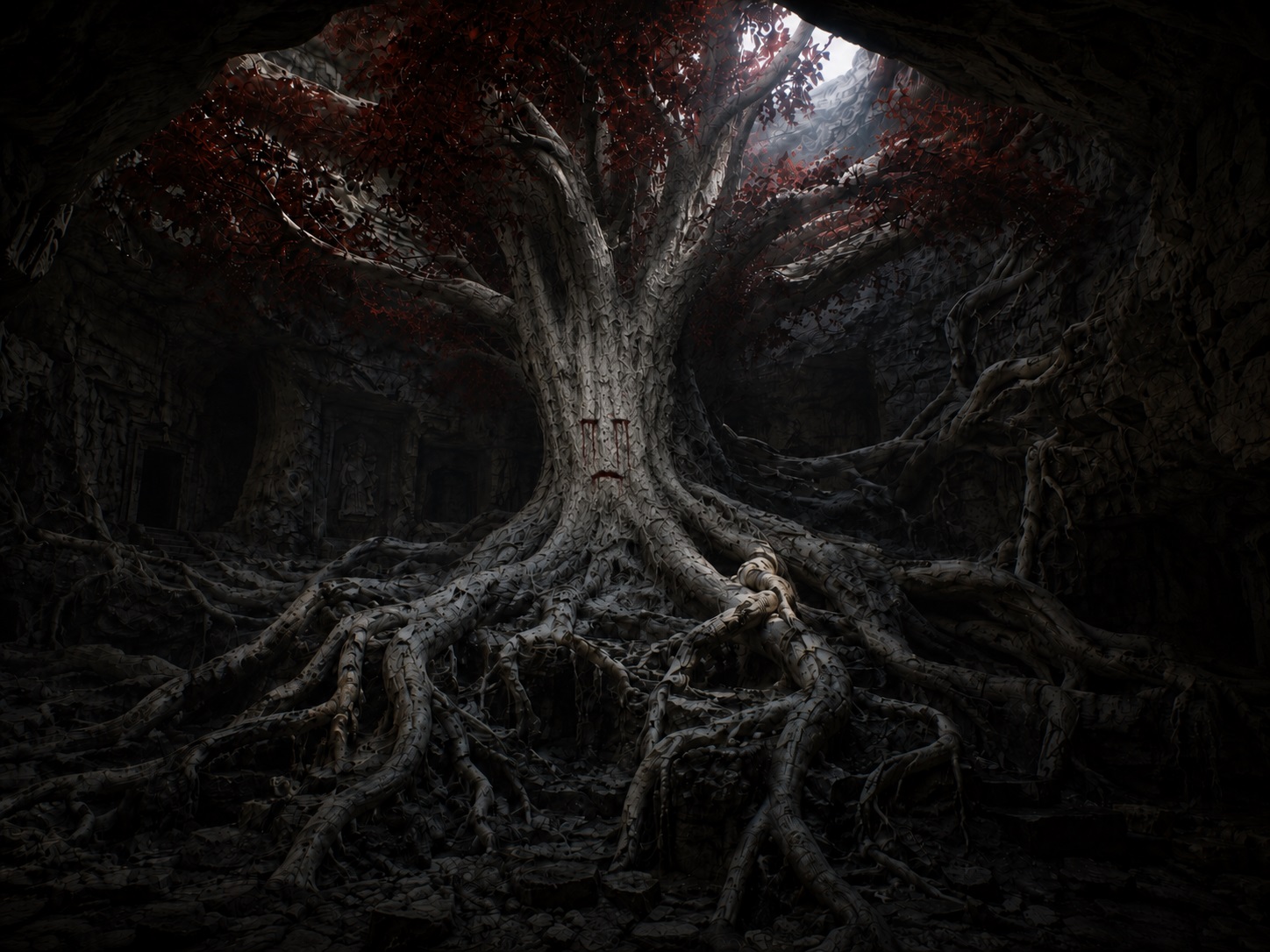
The weirwood growing within Casterly Rock’s Stone Garden is one of the most mysterious and underexplored heart trees in Westeros. Unlike Winterfell’s heart tree, which lives in a lush godswood beside a dark pool, populated by a variety of tree species and other vegetation, its branches stretching skyward through open air, the Stone Garden tree is buried in the ground, out of sight in a cave, cut off from sun and worship, ignored by the Lannisters who pass above it. Though the information we have is limited to a couple of lines, it may be one of the most symbolically potent heart trees in the known world.
There is even a godswood of sorts, though the weirwood that grows there is a queer, twisted thing whose tangled roots have all but filled the cave where it stands, choking out all other growth.
— The World of Ice and Fire, The Westerlands: Casterly Rock
From a biological standpoint, this tree presents an immediate mystery. Despite living within a cave carved into solid stone, the weirwood is not merely surviving, it is thriving in its own grim fashion. This stands in stark contrast to the Eyrie, where repeated attempts to grow a weirwood have failed entirely, apparently because the ground there is too stony and barren to support its growth. Why does one weirwood flourish in stone while another cannot take root? The question will receive its own treatment elsewhere. Here, it is enough to note the paradox: the Casterly Rock tree defies the conditions that defeat its kind elsewhere.
It’s also worth noting that weirwoods normally do strive upward toward the sky. There are many examples of towering weirwoods in the narrative, massive in both girth and height. Even the young sapling growing in the kitchen of the Night Fort stretches skyward:
Bran could hear the soft crackle of the flames, the wind stirring the leaves in the night, the creak of the skinny weirwood reaching for the moon.
– A Storm of Swords – Bran IV
Jon, while experiencing a wolf-dream during which he communicates with his brother Bran via a young weirwood, also notices its upward striving. Note that, as with the Casterly Rock tree, this weirwood also seems to have no problems sprouting from stone. The difference is these young saplings have the space to grow skyward.
Jon? The call came from behind him, softer than a whisper, but strong too. Can a shout be silent? He turned his head, searching for his brother, for a glimpse of a lean grey shape moving beneath the trees, but there was nothing, only … A weirwood. It seemed to sprout from solid rock, its pale roots twisting up from a myriad of fissures and hairline cracks. The tree was slender compared to other weirwoods he had seen, no more than a sapling, yet it was growing as he watched, its limbs thickening as they reached for the sky.
– A Clash of Kings – Jon VII
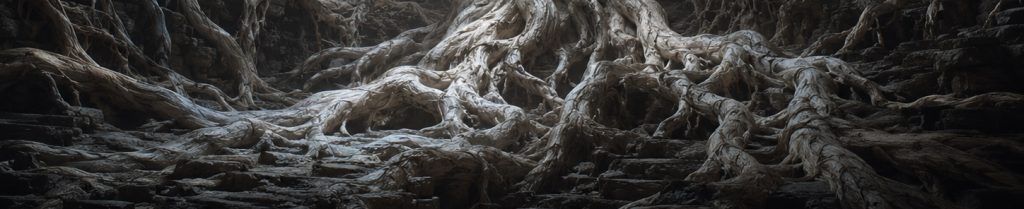
Since the Stone Garden is located within a cave, we can assume light is minimal, if present at all. This rules out traditional photosynthesis as its primary nourishment – if indeed weirwoods photosynthesize at all. Whatever the case, plants do need nutrients, both minerals and organic matter and the latter is scarce in rock. Further, since House Lannister worship the Seven rather than the Old Gods, no ritual sacrifices feed the tree in the traditional or perhaps supernatural sense. What, then, sustains it? Its roots have overwhelmed the entire cave space horizontally, suggesting they cannot penetrate deeper into the bedrock. This tree has nowhere else to go. It spreads sideways, not downward or upward, creating an aggressive, suffocating network that chokes out other plant life in the cave.
Spiritual Sustenance?
How does the Casterly Rock weirwood sustain itself? One possible explanation lies in the deep past. Though the Lannisters do not venerate the Old Gods, the land upon which Casterly Rock sits was once inhabited by the children of the forest. The World of Ice and Fire confirms that the Westerlands were originally their domain — alongside giants and other early denizens — and suggests the children may once have lived within the Rock itself. Could this weirwood still be drawing spiritual nourishment from ancient memories embedded in the stone? Residual echoes of an age when the Old Gods were venerated in this very place, their rites performed in the same caves now given over to Lannister gold?
We usually think of weirwoods specifically as repositories of memory and of souls but Varamyr’s thoughts on the deaths of his parents suggest the spirits of the dead reside within all of nature, including stone:
Years later he had tried to find his parents, to tell them that their Lump had become the great Varamyr Sixskins, but both of them were dead and burned. Gone into the trees and streams, gone into the rocks and earth. Gone to dirt and ashes. That was what the woods witch told his mother, the day Bump died.
– A Dance with Dragons – Prologue
This is later confirmed by Leaf, in answer to Bran’s inquiry about where the rest of the children of the forest have gone:
“Gone down into the earth,” she answered. “Into the stones, into the trees.
– A Dance with Dragons – Bran III
This possibility opens onto something more unsettling. If the tree survives not by regular means, but by tapping the layered memory of the rock, then its continued existence suggests a form of spiritual osmosis: Could it be feeding and thriving on the accumulated history, memories or consciousness within the rock, rather than on minerals, organic matter or blood? In fact, does consciousness, disembodied or otherwise, constitute a weirwood’s main menu? This scenario would explain the burial of the deceased beneath weirwoods, such as in the case of Raventree, or the proximily of the Winterfel Crypts to the godswood as well as the multitude of bones present in the children’s cave.
But the implication goes further: the tree may be a psychic sponge soaking up not only the memories of the ancient past, but also the imprint of recent and current events — the psychic and emotional residue of the Lannister legacy itself. Like the House it shares space with, this weirwood consumes everything within its domain. Its roots have so overrun the cave that no other plant survives. It does not share its space, instead, it smothers. And in this way, it reflects the Lannisters with an almost uncomfortable precision.
Weirwood Roots and Lannister Expansion
Lan the Clever
The Lannister story begins with Lan the Clever, a trickster who swindled the original Casterlys out of their ancestral seat through subterfuge rather than open warfare. This is the first instance of choking out the original growth of the Rock: not by conquering what came before, but by displacing it. Myth also credits Lan with fathering a hundred sons and a hundred daughters, living to the age of three hundred and twelve. The core idea, stripped of its exaggeration, is one of unchecked proliferation: so many Lannisters emerged that the Rock could no longer contain them, forcing the family outward to found Lannisport and eventually to extend their dominion across an entire coastline and economy.
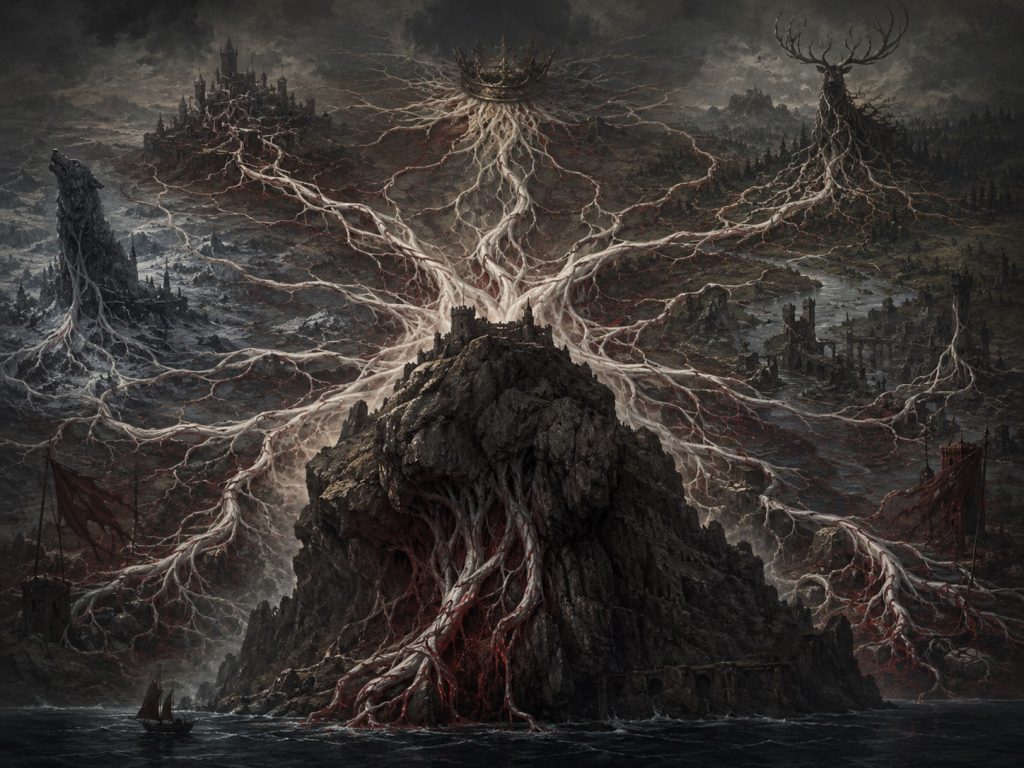
The weirwood’s roots, in this view, symbolize the sprawling physical, economic, and ideological dominance of House Lannister, a dominance born of accumulation and displacement.
When Ned Stark is informed that King Robert is bringing the Lannisters to Winterfell, his response is instinctive and charged: “Well, if the price for Robert’s company is an infestation of Lannisters, so be it.“ This is no throwaway line. The word infestation belongs to the language of invasive biology, reflecting something pervasive and overwhelming, that spreads from within. It maps onto the Stone Garden weirwood with uncanny exactness. Indeed, by using this terminology, Ned names the governing logic of Lannister power.
This approach is worth tracing through the historical and narrative record, because it is consistent and cumulative. The Lannisters exhibit a pattern of infiltration, absorption, and the systematic elimination of competing growth to extend and consolidate their power and reach.
Overwhelming a Bloodline
The most audacious expression of this is the one hidden in plain sight: Cersei’s children are not Robert Baratheon’s sons, but Jaime Lannister’s. They are pure Lannister offspring passed off beneath a royal banner. House Baratheon becomes, in effect, a host for a cuckoo’s lineage, its royal line hollowed out from within. This is not conquest by sword but by substitution, and it is the ultimate form of the root-system method: the original plant is not torn out but starved of everything it needs, while an invasive species spreads through the space it once occupied.
The Rains of Castamere
Where infiltration is impossible, eradication serves. Tywin Lannister’s destruction of House Reyne and House Tarbeck — two powerful vassals who dared to challenge Lannister authority — was not merely punishment. It was purification: the clearing of rival root systems to ensure that nothing else could compete for the same soil. “The Rains of Castamere” is the cultural memory of this eradication, a song that functions as a warning, and that has served its function faithfully ever since.
The Stark Bloodline
The same principle plays out across the War of the Five Kings with methodical thoroughness. The marriage of Sansa Stark to Tyrion is a legal mechanism for seizing Winterfell by proxy, with the intention of extending Lannister roots into the far North. Joffrey’s execution of Ned Stark removes the North’s leader and moral center and clears the ground for Lannister incursion. The Red Wedding — orchestrated with Lannister involvement — extinguishes Robb Stark’s line and scatters his political claim before it can take full root. This is botanical strangulation: the cutting of a young tree before it matures into something that might rival the established canopy.
Post-War Grafting
Once their enemies are diminished, the Lannisters redistribute the land. House Darry passes to Lancel Lannister, extending the family’s roots into the Riverlands. Riverrun, the ancestral seat of House Tully, is given to a Frey who married into Lannister alliance. This represents a graft, rather than an organic inheritance, one that bends a once-proud house into bearing Lannister fruit. In botanical terms, the result is not diversity or renewal, but a creeping monoculture: a single house expanding until all others are absorbed or erased.
This is the Lannister method realized as ecology. The Stone Garden weirwood, whose roots choke out all other life in its cave, is not merely a striking image, it is an allegory with historical content. The tree does not grow skyward; it spreads laterally, infesting, consuming and stifling. Its mode of existence is not creative but absorptive, not generative but suffocating. And this, precisely, is the mode of the house that has grown up around it.
Chthonic Resonance
In classical mythology, the underworld was not merely a realm of the dead but a repository of memory, prophecy, and ancestral truth. The Oracle at Delphi inhaled vapors rising from the earth; the Cumaean Sibyl descended into caves to deliver her pronouncements. These deep places of the world were understood to hold the unseen, the unspoken, the accumulated weight of everything that had been buried. The Casterly Rock weirwood, sealed in its cave and choked by its own roots, belongs to this tradition. It does not reach upward to commune with the heavens. Instead, it pulls inward, drawing from what lies beneath.
This downward orientation places the Stone Garden tree in stark contrast to the archetype of the World Tree — the axis mundi — found across mythological traditions. Yggdrasil, the cosmic ash of Norse cosmology, connects heavens, earth, and underworld along a sacred vertical axis. Its branches extend into the divine realm; its roots descend into the waters of wisdom and the realm of the dead. It is a bridge and a mediator, uniting all spheres of existence in one living structure.
The Casterly Rock weirwood is not a bridge. It is a sink. It does not mediate between realms, it descends into one, and stays there. Without skyward aspiration, it offers no communion with higher powers, no conduit for divine wisdom. Its entire vitality is focused below, in a root system that spreads laterally and smothers all else. This tree is not celestial. It is chthonic to its core.
Its chthonic nature is not primarily about death, however, but about dominion through descent, about tapping the foundational layers of legacy and influence rather than seeking the light. In this sense, the Lannisters and their tree share a common orientation. They do not operate as heroic founders or sacred kings, figures who derive authority from a covenant with something higher than themselves. They are, in mythological terms, closer to cave-dwelling serpents, or to the chthonic powers who reign over shadow rather than light and life. Perhaps this is why House Lannister holds the position of Warden of the West – the orientation of sunset, the transition between daylight and darkeness of night.
If the godswoods of the North still honor the axis mundi — the living tree as cosmic center, root and crown both reaching toward meaning, as we see with the Winterfell heart tree — then Casterly Rock represents an inversion of this theme: a labyrinthine tangle of control, ambition, and erasure, thriving in the dark beneath a castle that presumably pays no particular mind to it.
Conclusion
Ned Stark’s offhand remark — an infestation of Lannisters — now seems less like casual contempt and more like the revelation of an unconscious truth. The infestation is not merely political. It is spiritual, generational, and ecological: a family whose method of survival and expansion mirrors the behavior of the weirwood that lives in the dark beneath their seat of power.
The Casterly Rock weirwood is not worshipped or acknowledged by the family above it. And yet it persists, drawing on whatever the stone remembers, spreading its roots through every available space, crowding out all other life. It thrives not in spite of being underground but because of it, because its kind of growth requires nothing more than room to spread.
In this, the tree is the most honest portrait of House Lannister that the world of Westeros offers: not the golden hair, nor rampant lions, not the words Hear Me Roar, but a pale, gnarled thing in a cave, its roots wrapped around the foundations of everything, feeding on Lannister pride, and enduring.
Also check out this post: The Effects of Fire on Weirwood Trees
Images in this post are AI-Generated.