The Raventree Weirwood
Podcast version
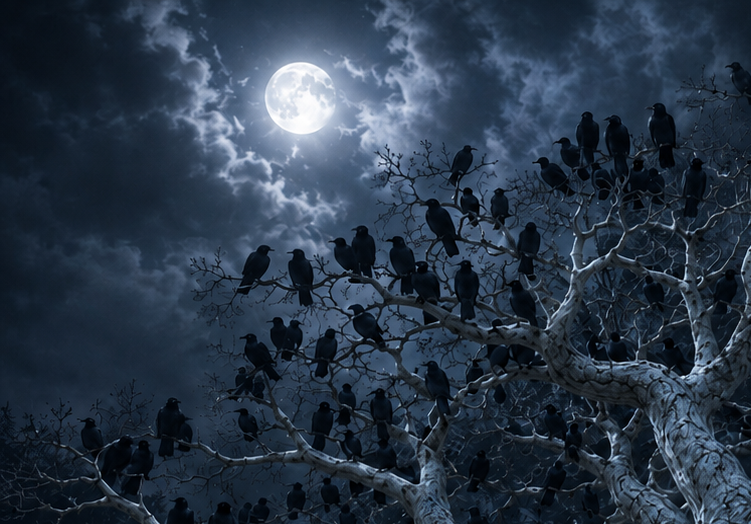
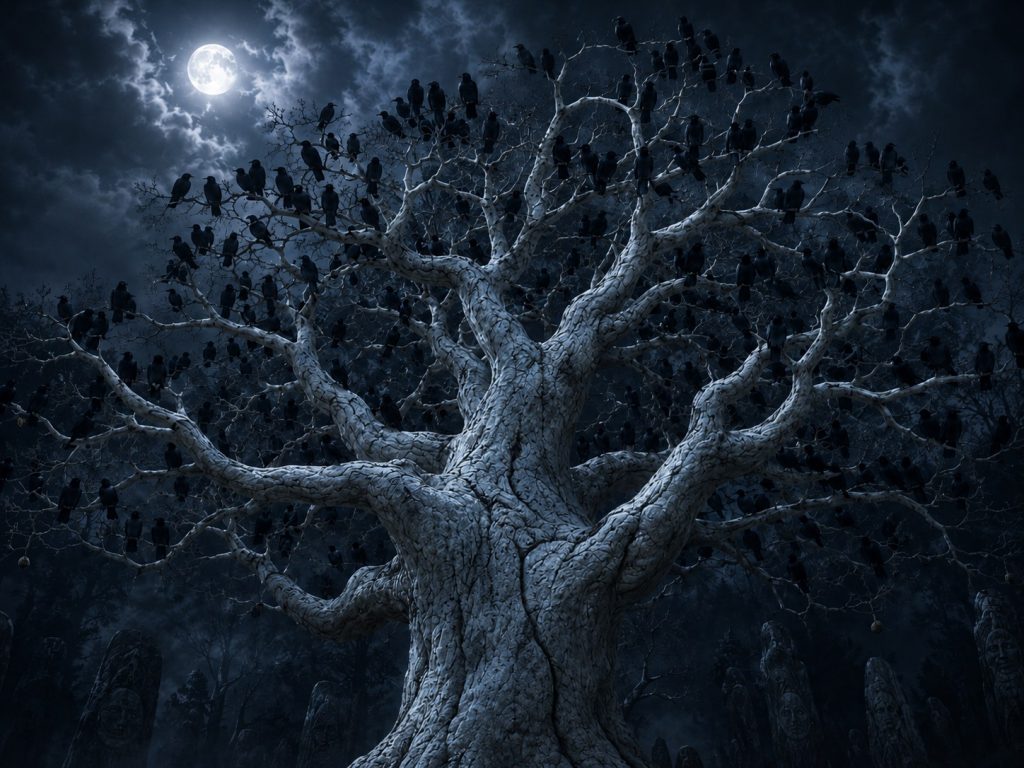
Every night, hundreds of ravens descend upon the dead weirwood of Raventree Hall. They settle onto its vast, bare limbs like black leaves on a tree that has not grown a single leaf of its own in a thousand years. The Brackens poisoned it, the Blackwoods say — though the Brackens deny this, and after a millennium, who can prove either claim? What matters is this: the tree is dead. Its upper branches, visible from leagues away, reach into the sky like bony fingers. No red leaves rustle in the wind and yet, every evening, the ravens come.
This is odd. We know what ravens prefer when given a choice between living and dead weirwood. At the Citadel in Oldtown, the oldest building, the Ravenry, sits on the Isle of Ravens, and in its courtyard grows an ancient weirwood. Half of it is alive, half dead. The living half still bears red leaves; the dead half is bare. And the ravens? They perch exclusively on the living branches. They fill the red-leafed side of the tree, otherwise crowding the windows and battlements, while the dead wood stands empty.
An ancient weirwood filled the yard, as it had since these stones had first been raised. The carved face on its trunk was grown over by the same purple moss that hung heavy from the tree’s pale limbs. Half of the branches seemed dead, but elsewhere a few red leaves still rustled, and it was there the ravens liked to perch. The tree was full of them, and there were more in the arched windows overhead, all around the yard.
– A Feast for Crows, Sam V
So why do the ravens gather at Raventree’s weirwood, where no living branch remains?
Raventree’s godswood contains other ancient trees. The ravens could roost anywhere but they don’t. They return to the weirwood, night after night, settling onto dead wood in numbers so great that Jaime Lannister, riding past, mistakes them for foliage. The question is: what are they responding to, if anything?
I think the answer lies beneath the surface. The tree may be dead above ground, but its root system — ancient, colossal, embedded in thousands of years of Blackwood burial earth — may still be alive. And if individual weirwoods function as memory nodes in a psychic network, then Raventree’s weirwood may be traumatized, but not inert. The ravens are gathering because it still remembers.
Weirwoods do not Rot, they Petrify
The phrase “weirwoods never rot” appears in the text as an aside, delivered by Tytos Blackwood to Jaime Lannister when explaining the state of his poisoned heart tree. It sounds like folklore, but the maesters agree: rather than decomposing like ordinary trees, weirwoods turn to stone over time. Tytos tells Jaime that in another thousand years, the tree will have fully petrified. This is not death as we understand it is not a normal process of fossilization either. The latter requires specific conditions such as rapid covering by layers of sediment to protect from scavengers, oxygen and weathering – followed up by mineralization. In any case the tree shows no signs of decay. If decomposition is an organism’s return to the earth, then this particular kind of petrification perhaps represents its refusal to leave.
The external indicators of life — sap, leaves, the whispering of wind through branches — have ceased, but the structure endures. And if weirwoods are repositories of memory, as the children of the forest claim, then their petrification may preserve that function long after biological activity has stopped. A petrified weirwood may be like a detached hard drive: the data remains, even if the system is no longer running.
Two examples suggest this is not speculation.
Jaime Lannister and the Dream on the Stump
In A Storm of Swords, Jaime Lannister sleeps against the stump of a dead weirwood during a rainstorm. That night, he dreams. He descends into Casterly Rock, hearing the voices of his ancestors and faces judgment from his former brothers of the Kingsguard as well as Rhaegar Targaryen, whose oaths he broke. He sees his father and Cersei, cold and dismissive. Brienne of Tarth joins him, asking if they keep a bear down there. When he wakes, something in him has shifted. He turns his horse around, rides back to Harrenhal, and rescues Brienne from Vargo Hoat’s bear pit.
This implies that even a stump can stir memory or conscience in those who rest near it. The visible tree is gone, but the root system beneath may still function as a psychic resonance point, reaching into the unconscious of those attuned to it. Jaime past actions return to haunt him, and the weirwood offers him a mirror.
The Hill of High Heart
High Heart was once the site of a massive weirwood grove, sacred to the children of the forest. The Andals destroyed every tree, leaving only the stumps of thirty-one pale once mighty trunks. The grove has been dead for thousands of years.
Yet Tom Sevenstrings, who knows the Riverlands well, tells Arya that “some of their magic lingers here still.” The smallfolk avoid the hill, claiming it is haunted by the ghosts of the children who died defending it. And the Ghost of High Heart — a wizened, prophetic crone — lives somewhere around or under the hill and cannot escape her dreams:
“The old gods stir and will not let me sleep.”
She prophesies with unnerving accuracy. She sees the Red Wedding, the death of kings, and other events, before they happen. If the trees are gone, what is stirring? What won’t let her sleep?
The answer, I think, is the roots. Though the trunks were cut and the branches burned, the root systems beneath High Heart remain intact, buried in the earth where the children of the forest died. And if the children went “down into the earth,” as Leaf tells Bran — “into the stones, into the trees” — then the roots may still hold their memory. The grove is not magically inert. It is muted, silenced above ground, but still humming beneath the soil with an old frequency some few can tune into.
These two examples establish a principle: dead or damaged weirwoods do not lose their function as memory nodes. They lose their voice — the rustling of leaves, the visible signs of life — but the deeper structure, the root system, remains psychically active. They are like neurons that have stopped firing but still retain their synaptic connections, waiting for the right stimulus to activate them again.
Raventree’s Weirwood: Dead Above, Alive Below
Raventree’s weirwood has been poisoned for a thousand years. Tytos Blackwood tells Jaime that the maesters predict it will turn fully to stone within another millennium, meaning it is currently in the process of petrifying. The poisoning did not cause immediate collapse or rapid decay; it triggered a slow hardening that preserves the tree’s structure even as it kills the living tissue above ground.
But what about below ground?
The roots of a weirwood this colossal — a tree whose upper branches can be seen from leagues away — would extend deep and wide, anchoring themselves in the earth like the foundation of a cathedral. Unlike the branches, which are exposed to air and weather, the roots are protected. They are buried in soil that has been fed by Blackwood dead for over a thousand years.
Tytos Blackwood wants to bury his son Lucas beneath the weirwood. He says this explicitly to Jaime, lamenting that the Freys have not yet returned Lucas’s bones after the Red Wedding. The Blackwoods treat the weirwood as a burial site, a place where the dead are laid to rest and, implicitly, where their memory is preserved. If Tytos wants Lucas buried there despite the tree being dead for a millennium, then the Blackwoods still believe the tree functions as a conduit to the afterlife or to ancestral memory.
This belief aligns with what we know about the cosmology of the Old Gods. Varamyr Sixskins, dying beyond the Wall, recalls the woods witch’s words to his mother when his brother Bump died:
“Gone into the trees and streams, gone into the rocks and earth. Gone to dirt and ashes.”
Later, Leaf confirms this to Bran when he asks where the rest of the children of the forest have gone:
“Gone down into the earth. Into the stones, into the trees.”
The dead do not simply decay. They are absorbed. If the children of the forest go into the earth and into the trees, and if weirwoods are the Old Gods’ memory network, then burial at the base of a weirwood is not simply respectful — it is functional. The dead nourish the tree. The tree holds the memory. The roots act as a conduit between the living and the dead, between the present and the past.
So here is what we may have: a tree that is dead above the surface — no sap, no leaves, no visible life — but whose root system remains intact, embedded in burial earth, still absorbing the dead. The memory node is damaged, traumatized by poisoning, but not destroyed. The data is still there, encoded in the roots, sustained by the slow accumulation of Blackwood ancestors going down into the earth.
And every night, the ravens come.
Stone as a Vessel: The Persistence of Spirit
Before we address what the ravens are doing, we must consider a deeper principle at work in Martin’s world: stone is not a tomb; it is a preservative. Petrification does not erase consciousness or life-force, rather it encases it, suspending it in a state that can be reawakened under the right conditions. This appears across multiple contexts in the text, and recognizing it strengthens our understanding of what Raventree’s petrifying weirwood may still contain.
Dragon Eggs Turned to Stone
The dragon eggs that Daenerys receives as a wedding gift are described as ancient, turned to stone over centuries. They are beautiful decorative objects until they are subjected to blood magic and fire. Daenerys walks into Khal Drogo’s funeral pyre with the stone eggs, and Mirri Maz Duur dies in the flames. When the fire burns out, three living dragons have emerged from the cracked stone shells.
What does this tell us? That the petrification process did not extinguish the life within the eggs — it suspended it. The dragons’ spirits or essence remained locked inside the stone, dormant but not dead, waiting for the correct catalyst to reawaken them. The stone was not a grave; it was more a cocoon. And the catalyst required death — “only death can pay for life,” as Mirri Maz Duur says, a phrase that echoes through the series as a fundamental magical principle.
The Stone Men of the Sorrows
Greyscale is a disease that turns living flesh to stone, but the afflicted remain conscious. They retain their memories and awareness even as their bodies harden and cease to function. The disease is described as a slow entombment: the spirit is still present, but the body becomes its prison.
The principle is the same: stone does not erase the spirit; it encases it.
The Kings of Winter in the Crypts
This is perhaps the most direct parallel to Raventree. The dead Stark kings are buried beneath Winterfell, their stone effigies sitting above them with iron swords laid across their laps. And Martin consistently writes them as if they are present, not merely symbolically but actually:
- Jon feels their disapproval when he visits the crypts.
- Their eyes seem to watch visitors to the crypts.
- Ned feels they are listening and wonders whether the rusted swords mean those kings’ spirits are no longer bound, free to roam.
The swords function as a kind of spiritual lock. As long as the iron is intact, the spirit is contained within the crypt. When the iron rusts away, the binding may weaken or break. This implies that the spirits of the dead Starks are still there, held in place by ritual and iron, waiting.
Some readers theorize that the Horn of Joramun, the Horn of Winter, will “wake the dead” — literally awakening these ancient kings from their stone tombs. Whether that happens or not, the text treats the crypts as a site of suspended consciousness, not final death. The stone statues are not just memorial symbols; they are anchors for the spirits they represent.
The Pattern Across Martin’s World
What all three examples share is this: stone is a preservative medium for consciousness or life-force, and reawakening what is locked in stone requires a catalyst, often involving death or blood.
- Dragon eggs: reawakened by fire and human sacrifice.
- Stone men: trapped in stone by disease, alive but losing agency.
- Kings of Winter: bound in stone by iron swords, potentially reawakened by the Horn of Winter.
And now, Raventree’s weirwood: petrifying slowly, its roots embedded in burial earth, fed by a millennium of Blackwood dead. If the pattern holds, then the weirwood’s petrification does not erase the consciousness or memory it once held — it preserves it. The tree is no longer biologically alive, but it may still function as a memory vessel, sustained by the ongoing ritual of burial.
The Blackwoods, knowingly or not, are performing a version of the same principle: death nourishes the stone, and the stone holds the memory. They bury their ancestors at the base of the tree, and the tree, though dead above ground, continues to absorb them into its root system. The ravens, then, may be responding not to biological vitality but to the concentration of ancestral memory locked within the petrifying weirwood.
The Whispering of the Leaves
When weirwoods are alive and functioning, they speak through their leaves. The rustling of red leaves in the wind is not mere ambient noise — it is the voice of the Old Gods, the medium through which memory can be transmitted.
Jojen Reed, who has the greensight, describes the gift explicitly in terms of auditory perception:
“The greensight is the blessing to hear the whisperings of the leaves and see as the trees see.”
Hearing the whisperings of the leaves is not a metaphor for having visions. It is a literal sensory ability: those with greensight can hear what the weirwoods are saying through the movement of their red leaves. The leaves are the interface. They are the speakers through which the weirwood network transmits information.
Osha, the wildling woman who serves the Starks, understands this instinctively. When Bran expresses doubt about whether the gods can hear him, she explains:
“You asked them and they’re answering. Open your ears, listen, you’ll hear.”
Bran listened. “It’s only the wind,” he said after a moment, uncertain. “The leaves are rustling.”
“Who do you think sends the wind, if not the gods?” […] “They see you, boy. They hear you talking. That rustling, that’s them talking back.”
“What are they saying?”
“They’re sad. Your lord brother will get no help from them, not where he’s going. The old gods have no power in the south. The weirwoods there were all cut down, thousands of years ago. How can they watch your brother when they have no eyes?”
– A Game of Thrones – Bran VI
This is extraordinary. Osha is not simply affirming that the gods exist, she is interpreting what the rustling leaves are saying. She hears sadness in them. She understands that the gods are lamenting Robb’s journey south, where the weirwoods have been cut down and the Old Gods have no presence. The rustling is not random; it is communication, and those who know how to listen can decode it.
Theon Greyjoy experiences this directly. Standing before the heart tree, he hears something:
“Theon,” a voice seemed to whisper.
His head snapped up. “Who said that?” All he could see were the trees and the fog that covered them. The voice had been as faint as rustling leaves, as cold as hate. A god’s voice, or a ghost’s.
– A Dance with Dragons – The Prince of Winterfell
The voice is as faint as rustling leaves. Theon hears his name spoken by the tree, and what he perceives audibly is the sound of leaves moving in the wind.
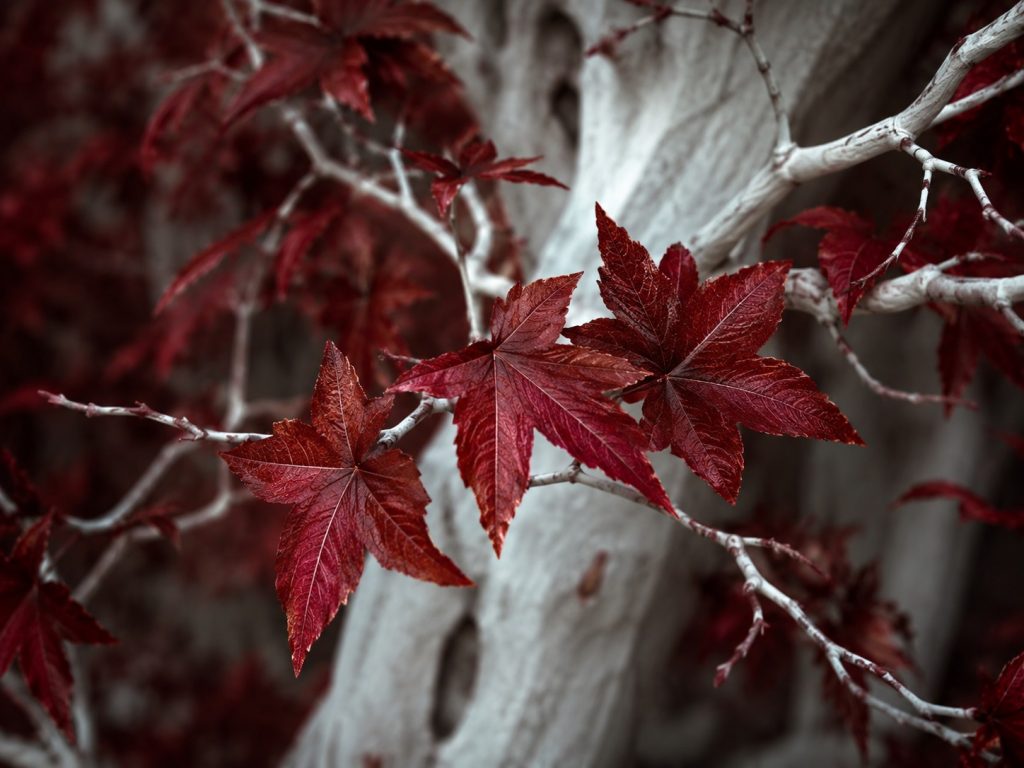
Even Daenerys, far from Westeros and untrained in the ways of the Old Gods, feels drawn to the sound of leaves whispering. Standing on a terrace in Meereen, she finds comfort in “the sound of the leaves whispering to one another.” She does not understand what they are saying, but she senses that they are saying something and that the rustling is a conversation, not mere wind.
Sam perceives similarly:
He heard the dark red leaves of the weirwood rustling, whispering to one another in a tongue he did not know.
– A Storm of Swords – Samwell III
The implication is clear: a weirwood without leaves is a weirwood without a voice. It may still see (through its carved face), it may still remember (through its roots), but it cannot speak. The rustling of leaves is one way in which the Old Gods communicate with the living, how memory is transmitted across the network, how greenseers “hear” what the trees have witnessed.
And Raventree’s weirwood has had no leaves for a thousand years.
The tree has been silent all that time. The Blackwoods cannot hear it whisper. The gods cannot speak through it. Whatever the tree remembers, whatever knowledge is locked in its roots and its petrifying wood cannot be transmitted the way other weirwoods transmit their memory. The interface has been severed. The voice has been cut off.
But the ravens still come. And if the leaves once whispered, and the ravens now gather where the leaves once were, then perhaps the ravens have become the whisper.
Huginn and Muninn: Thought and Memory
In Norse mythology, the god Odin has two ravens: Huginn and Muninn, whose names translate as Thought and Memory. Every morning, they fly across the Nine Worlds, gathering news and witnessing events. Every evening, they return to Odin and whisper what they have learned into his ears. Their function is so essential that Odin himself admits he fears for their return, particularly for Muninn:
“Huginn and Muninn fly each day over the spacious earth. I fear for Huginn, that he come not back, yet more anxious am I for Muninn.”
— Grímnismál, stanza 20
Odin worries more about Memory than Thought. Memory is the anchor. Without it, there is no continuity, no connection between past and present. Thought can be regenerated; Memory, once lost, is irrecoverable.
George R.R. Martin has explicitly invoked this myth. In a 1999 interview, when asked why ravens are used as messenger birds in Westeros instead of pigeons, Martin acknowledged that ravens are not necessarily better carriers in real-world terms but he chose them for their mythic resonance:
“I also liked the mythic resonances. Odin used ravens as his messengers, and they were also thought to be able to fly between the worlds of the living and the dead.”
Ravens, in Martin’s conception, are not just birds. They are psychopomps — creatures that move between realms, carrying messages not only across physical distances but across metaphysical boundaries. They are intermediaries between the living and the dead, between the present and the past, between the world of men and the world of gods.
And in the earliest days of Westeros, this function was literal.
Bloodraven tells Bran:
“It was the singers who taught the First Men to send messages by raven… but in those days, the birds would speak the words. The trees remember, but men forget, and so now they write the messages on parchment and tie them round the feet of birds who have never shared their skin.”
– A Dance with Dragons – Bran III
Ravens originally spoke. They did not carry written messages; they delivered them aloud, in the True Tongue, the language of the children of the forest. The singers would skinchange into the ravens and speak through them directly. The communication was immediate, unmediated by parchment or literacy. The ravens were living extensions of the singers’ consciousness, moving freely across great distances while themselves remaining rooted in place.
But that knowledge has been lost. Men no longer understand the True Tongue. Neither skinchangers or the children walk among men south of the Wall. And so the ravens have been reduced to carriers of parchment, performing a degraded version of their original function. The system still works but the deeper layer of communication, the psychic link between sender and receiver, has been severed.
This is the context in which we must understand the ravens of Raventree Hall.
They gather nightly on a tree that cannot whisper. They settle onto bare branches that have borne no leaves for a thousand years. And they do this in a world where the knowledge of how to use them — how to skinchange into them, how to speak through them, how to understand what they carry — has largely been forgotten.
The Oracle of Dodona: When Trees Lose Their Voice, Birds Become the Whisper
There is another mythological parallel worth considering, one that complements the Norse image of Odin’s ravens. In ancient Greece, long before the Oracle of Delphi rose to prominence, the oldest Hellenic oracle was located at Dodona, in the mountains of Epirus. There, the god Zeus spoke not through a human priestess but through the rustling of leaves in a sacred oak tree.
The priests and priestesses of Dodona would interpret the sounds made by the wind moving through the oak’s branches. But the oracle also employed another medium: the behavior of black doves that nested in the tree. Some accounts even suggest that the first priestess of Dodona was a black dove — perhaps a metaphor for divine speech channeled through birds rather than human voices.
This serves as a guide for what may be happening at Raventree:
- A sacred tree serves as the voice of the divine.
- That voice is conveyed through the rustling of leaves.
- When direct interpretation becomes difficult or the tree’s voice is obscured, birds become the oracular intermediaries.
- Only a trained priesthood can interpret the messages.
At Dodona, the oak was alive, and the priesthood was trained to interpret both the rustling leaves and the doves. At Raventree, the weirwood is dead, the leaves are gone, and there is no trained interpreter left who can understand what the ravens are doing. The system is still operating, but it is operating in the dark, performing a function that no one remembers assigning and no one can decode.
At Raventree, the ravens are the whisper now. They are Huginn and Muninn, Thought and Memory, circling back each night to a memory node that can no longer speak but may still be listening.
Ravens and the Spirits of the Dead
If we are to understand what the ravens are doing at Raventree, we must first ask: can ravens sense or interact with the spirits of the dead? The mythological evidence says yes — extensively. Ravens are psychopomps in multiple traditions, creatures that guide, witness, or communicate with the dead.
Norse Mythology: Odin’s Ravens and the Dead
We have already discussed Huginn and Muninn as Thought and Memory, but there is another layer: Odin himself is the god of the dead. He presides over Valhalla, where the slain warriors go, and he practices seidr, a form of shamanic magic associated with communication with the dead. His ravens are not just messengers among the living. They also travel between the worlds of the living and the dead, gathering knowledge from both realms.
In the Prose Edda, Odin is described as having the ability to “wake the dead and question them,” a practice that requires crossing the boundary between life and death. His ravens, as extensions of his consciousness, would necessarily participate in this crossing. They are not limited to the material world; they can perceive and interact with the spirit realm.
This is why George Martin’s explicit invocation of Odin’s ravens is so significant. He didn’t just choose ravens because they’re smart or ominous — he chose them because in myth, ravens are creatures that can fly between the worlds of the living and the dead.
Celtic Mythology: The Morrigan and Battle Ravens
In Irish and Welsh mythology, ravens are strongly associated with the Morrigan, a goddess of war, fate, and death. She often appears as a raven or crow on the battlefield, and her presence signals doom. But she is not merely a harbinger of death — she is a gatherer of the dead, a figure who witnesses the dying and guides their spirits.
The Morrigan’s ravens are said to feed on the corpses of the slain, but this is not simple scavenging — it is a ritual act. By consuming the flesh of the dead, the ravens are thought to carry the spirits of the warriors with them, either to the Otherworld or to the goddess herself. The ravens are intermediaries, moving between the battlefield (the world of the living) and the spirit realm (the world of the dead).
In Welsh mythology, the god Brân the Blessed (whose name means “raven”) is a giant king whose head is buried beneath the White Hill in London to protect Britain. Even after his death, his head continues to speak and provide counsel. The raven, in this tradition, is associated with the persistence of consciousness after death — the idea that the spirit can remain active, even when the body is destroyed or buried.
Native American Traditions: Raven as Trickster and Psychopomp
In many Indigenous North American traditions, Raven is a not only a trickster figure, but also a psychopomp — a guide for the dead. In some Pacific Northwest traditions, Raven is said to have created the world, but also to travel freely between the land of the living and the land of the dead, carrying messages and souls between the two.
Raven is often depicted as having knowledge that the living do not possess, precisely because he can see and hear what is happening in the spirit world. He is not bound by the limitations of mortal perception. This makes him a dangerous figure: he knows too much, sees too much but but is also essential because he can relay information from the dead to the living.
European Folklore: Ravens as Omens and Spirit Witnesses
In medieval European folklore, ravens are consistently associated with death, battlefields, and the souls of the dead. They are often depicted as gathering at sites of execution or mass death, and their presence is interpreted as a sign that the spirits of the dead are lingering.
In some traditions, ravens are thought to carry the souls of the dead, either to heaven or to hell. In others, they are believed to witness the moment of death and remember it, serving as living archives of who died and how. This makes them valuable to witches, seers, and those who practice necromancy. If you want to know what happened to the dead, you ask the ravens, who were there and saw it.
The Crone in ASOIAF
In the theology of the Faith of the Seven, the Crone is said to have let the first raven into the world when she peered through the door of death. The Crone represents wisdom and is prayed to for guidance. She is said to light the way through life with a golden lamp.
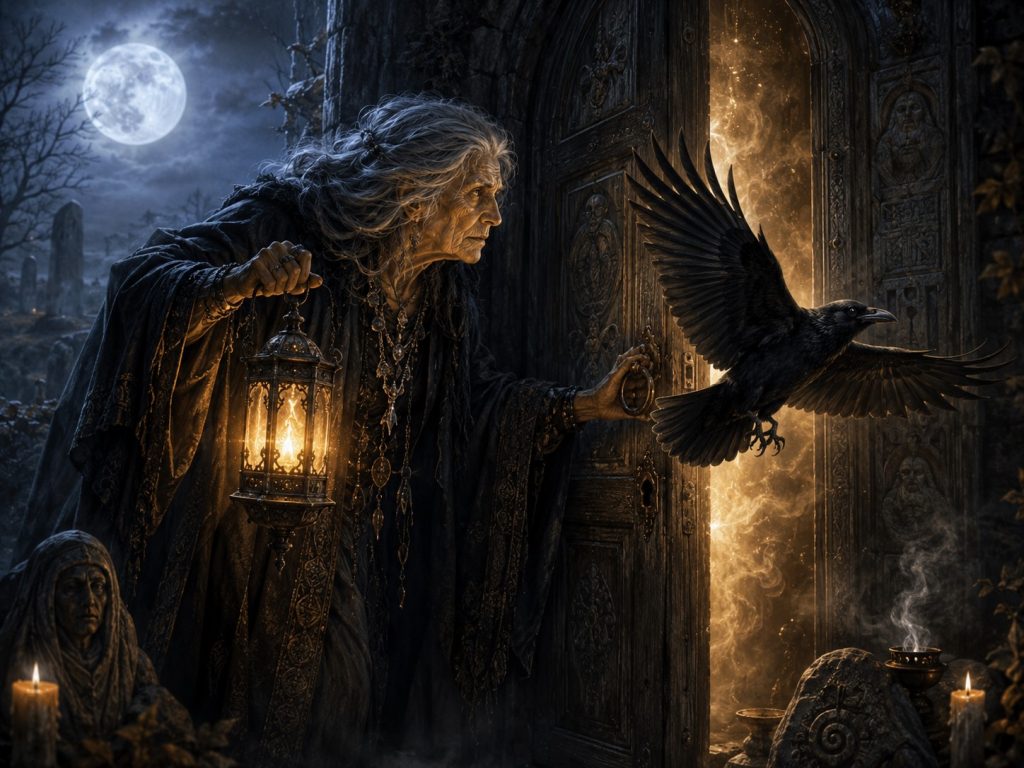
The Crone’s raven reveals one of the sources of her wisdom. She gains insight by looking through the door of death, and the raven enters the world as the living trace of that forbidden glimpse. This places the Crone in the same mythic pattern as Odin, the Morrígan, Brân, and other raven-associated figures who mediate between the living and the dead. The raven is not simply a clever bird or an omen of doom; it is a threshold-creature, a carrier of memory and knowledge beyond the mortal boundary. The Faith of the Seven has wrapped this in the gentle image of a wise crone and golden lamp, but the underlying symbolism is darker: true guidance may come from death-knowledge.
Application to Raventree Hall
Given this mythological context, the ravens’ nightly gathering at Raventree takes on a much clearer function. They are there because they can sense the spirits of the dead because the Blackwood ancestors have been buried at the tree’s base, and their spirits have gone “down into the earth, into the stones, into the trees.”
The weirwood’s roots are embedded in burial ground. If the spirits of the dead reside within the tree — locked into its petrifying structure, preserved rather than erased — then the ravens, as psychopomps, would be able to perceive this. They would be drawn to the concentration of ancestral memory, circling the tree not out of instinct but in response to a spiritual frequency that only they can detect.
In Norse terms, they are acting as Huginn and Muninn, gathering Memory from the dead each night. In Celtic terms, they are acting as the Morrigan’s ravens, feeding on (or witnessing) the dead and carrying their spirits with them. In Martin’s terms, they are fulfilling the function that the weirwood’s leaves once performed — they are the whisper now, the medium through which the tree now communicates, even though no living person at Raventree remains to interpret them.
The Ravens as Memory Bridges
We know from Bran’s training with Bloodraven that greenseers can access the weirwood network and look through the eyes of any living weirwood, witnessing past and present events that occurred in their presence. The weirwoods function as a distributed consciousness, a psychic network where each tree is a node that a greenseer can “log into” and query for stored memory.
But what happens when a node is damaged or severed from the network?
Raventree’s weirwood has lost its leaves — the mechanism through which weirwoods “whisper” and, presumably, one way of transmiting data across the network. If the leaves are the interface, the visible sign of network connectivity, then a leafless weirwood is a disconnected node. It can still store memory locally (in its roots, in the petrifying wood, in the burial earth), but it cannot transmit that memory to other nodes. Bloodraven, sitting in his cave beneath the Haunted Forest, can look through Winterfell’s but he may not be able to access Raventree’s tree directly, because the tree is no longer broadcasting. This creates a problem. The tree is “offline.” The data is there, but it’s trapped.
This is where the ravens come in.
If Raventree’s weirwood can no longer communicate with the broader weirwood network, but the ravens can still access the memories stored within the tree, then the ravens become mobile storage devices. They are couriers. They download memory from the severed node and carry it elsewhere, making that knowledge accessible to anyone who can interface with them.
How would a greenseer interface with a raven?
Skinchanging.
Bloodraven tells Bran that greenseers used to skinchange into ravens to send messages — the ravens would speak the message aloud in the True Tongue. But skinchanging is a two-way street. When you enter an animal’s mind, you don’t just control it — you experience what it experiences, know what it knows. Varamyr Sixskins, when he’s inside Orell’s eagle, can feel Orell’s hatred toward Jon Snow. Bran, when he’s inside Summer, can sense things through the direwolf’s heightened senses.
So if a raven has been to Raventree and accessed the memories stored in the tree by some kind of psychic osmosis, and a greenseer then skinchanges into that raven, the greenseer would be able to read the raven’s memory and thereby access the memory stored in Raventree’s weirwood, even though the tree itself is offline.
The ravens are not just witnesses. They are memory carriers, ferrying data from a severed node to any greenseer or skinchanger capable of reading them.
Mormont’s Raven: The Prototype
This is where Mormont’s raven becomes important. That bird is not a normal raven. It speaks — not just mimicking sounds but delivering phrases that are often contextually relevant.
The common fan theory is that Bloodraven is skinchanging into Mormont’s raven, using it as a remote viewing device and occasionally nudging events at the Wall. If that’s true — and the text strongly suggests it is — then we’re seeing exactly the mechanism described above in action:
- Bloodraven, sitting in his cave, skinchanges into a raven at Castle Black.
- While inside the raven, he can speak through it (limited vocabulary, but functional).
- He can also perceive what the raven perceives and access its memories.
Now apply that mechanism to Raventree. If Bloodraven (or Bran, or any greenseer) wanted to know what happened at Raventree Hall over the past thousand years — knowledge that is locked in the tree but inaccessible via the weirwood network — they could:
- Skinchange into one of the ravens that gathers at Raventree each night.
- Access the raven’s memory of what it witnessed or absorbed while perched on the tree.
- Retrieve the information that way.
The ravens are not replacing the weirwood’s function — they are compensating for the tree’s inability to broadcast. They are analog workarounds in a system where one node has gone dark.
Sam Teaching Ravens to Speak: The Lost Protocol
Sam actively trying to teach the ravens at Castle Black to speak is another key piece. He doesn’t know why it matters but we, the readers, can now see why it would matter:
If ravens could speak again, they could verbally report what they’ve witnessed.
Imagine a raven flying to Raventree, perching on the dead weirwood, accessing the memories stored there, and then flying back to Castle Black and speaking those memories aloud to Sam or Jon. No greenseer required. The raven itself becomes the interface.
This is what Bloodraven means when he says “the birds would speak the words.” The ravens weren’t just carriers of parchment messages, they were probably also verbal transmitters of psychic data. A greenseer would skinchange into a raven, fly to a location, observe or access memory, and then speak that information aloud when they returned.
Sam is unknowingly trying to restore a lost magical protocol. And the fact that he did this at Castle Black — where Mormont’s raven is already speaking, likely under Bloodraven’s influence — suggests that the capability is still there, dormant, waiting to be reactivated.
Where the Ravens Go
We have established what the ravens are doing: they are mobile data carriers, compensating for a severed node in the weirwood network.
But where do they go during the day? Whom do they fly to? Are they being skinchanged by a greenseer or skinchanger who can read their memories? We have no textual evidence to answer these questions definitively — but the absence of evidence is itself significant.
The text does not tell us where the ravens spend their daylight hours. It does not tell us whether anyone is accessing them. It does not tell us whether the Blackwoods themselves have ever tried to understand the nightly gathering, or whether they simply accept it as part of the tree’s sacred mystery.
What we can say is this: the ravens are performing their function correctly. They gather at the tree, access the memory and carry it with them. Whether or not anyone is currently drawing on that memory is a separate question and one that may have a different answer than we expect.
For all we know, the ravens are already being accessed. Bloodraven may be skinchanging into them regularly, extracting a thousand years of Blackwood history from the severed node. Or perhaps no one is accessing them yet, and the ravens are simply maintaining the protocol, waiting for someone to remember how to use them. The system is still running. The question is whether anyone is logged in.
What matters is that the capability exists. The memory is not lost. The tree may be offline, but the backup system is operational. And in a world where the Long Night is returning and the old powers are stirring, a thousand years of stored memory — knowledge of oaths, alliances, betrayals, feuds, and perhaps even the original cause of the weirwood’s poisoning — could be strategically invaluable.
The ravens of Raventree remember. And memory, as Odin knew, is more precious than thought.
Conclusion: A Memory Node, Not a Living Tree
Raventree’s weirwood is not alive in the conventional sense. It has no leaves, no sap, and no visible biological function above ground. In another thousand years, it will have turned fully to stone, completing the petrification process that weirwoods undergo instead of rotting. But petrification is not erasure. It is preservation. And if the roots beneath the tree remain embedded in burial earth, fed by a thousand years of Blackwood dead, then the tree may still function as a memory node — damaged, muted, but not inert.
The poisoning of the tree by the Brackens a thousand years ago was an act of trauma, a severance of the tree’s voice. It can no longer whisper through red leaves. It can no longer transmit memory audibly across the weirwood network, as other weirwoods do. But the root system, protected beneath the soil, may still be absorbing. The dead still go down into the earth. The spirits still enter the stones and the trees. And the ravens, who in myth are said to fly between the worlds of the living and the dead, can still gather the memories accumulated by the tree.
The ravens there because the Raventree weirwood still remembers. And in a world where the greenseers are gone and the True Tongue is forgotten, the ravens have become the only witnesses left — black leaves on a bare tree, Thought and Memory circling endlessly around a node that no longer broadcasts but may still be transmitting, waiting for someone to tune in and listen.
More Weirwood Mysteries:
The Effects of Fire on Weirwood Trees
Bran’s Wedding to the Weirwood

All images are AI-generated