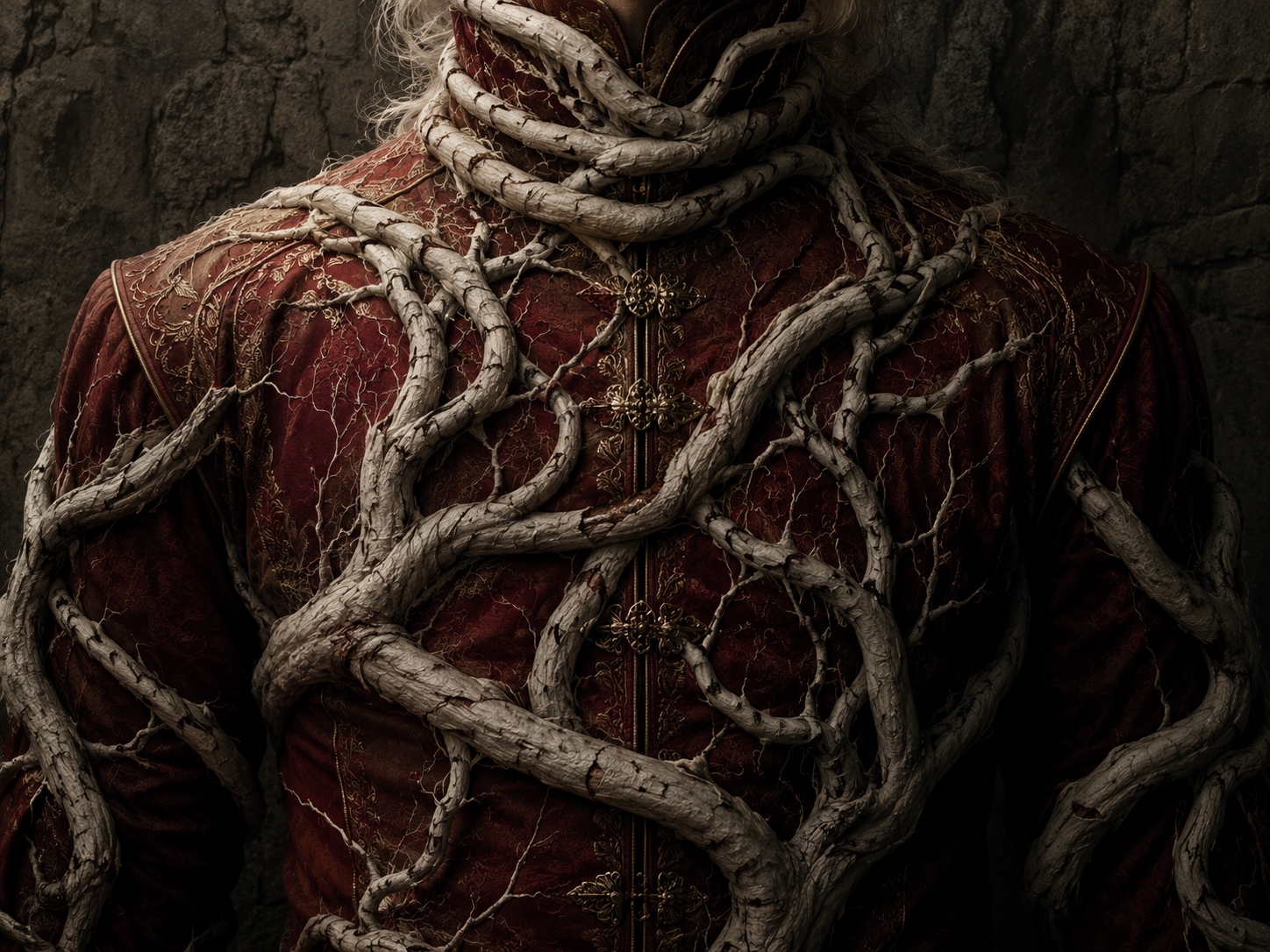
A Mirror in the Dark
In part one of the analysis of the Casterly Rock weirwood, I explored how the tree embodies the Lannister legacy of infiltration, expansion and dominance. Next, we shall take an even closer look, this time at how this weirwood is an almost perfect symbolic double for Tyrion Lannister: small, twisted and rooted in ancient heritage – a potential giant trapped within the confines of body or rock.
There is even a godswood of sorts, though the weirwood that grows there is a queer, twisted thing whose tangled roots have all but filled the cave where it stands, choking out all other growth.
— The World of Ice and Fire, The Westerlands: Casterly Rock
The Raventree weirwood in comparison:
It was a weirwood ancient and colossal, ten times the size of the one in the Stone Garden at Casterly Rock. This tree was bare and dead, though.
— A Dance with Dragons, Jaime I
The Stone Garden weirwood is not the grand living heart of an expansive northern godswood. It is puny in comparison to Raventree Hall’s immense visible and legendary, albeit dead, weirwood. Unlike the towering three singers of Highgarden, it appears to have no storied claim to fame either. Instead, it is buried inside Casterly Rock, reduced to a secret, almost shameful presence, unable to reach skyward. Yet those tangled roots have almost filled the cave, its trunk only a fraction of its potential reach.
That alone gives us the central parallel: Tyrion, like the Stone Garden weirwood, is stunted and akin to the tree in its cave and his roots spread laterally throughout the narrative, infiltrating the story at almost every turn. He is present at major hinges of the story: Bran’s fall and its aftermath, the Wall, the Eyrie, the Stark-Lannister conflict, the Battle of the Blackwater, Joffrey’s death, Tywin’s death, the plot surrounding Aegon’s campaign. He experiences slavery firsthand, becomes involved in the sellsword politics of Slaver’s Bay and is en route toward Daenerys where he will become part of her story.
The world sees him as small but he is central to the entire series. He is not marginal to the plot. He is one of its root systems.
That is the Stone Garden weirwood pattern: undersized trunk, enormous roots.
This essay is speculative, of course. We are not told that the Stone Garden weirwood symbolises Tyrion. In fact, beyond Casterly Rock, there is no obvious connection between them at all. But A Song of Ice and Fire repeatedly invites us to consider landscape, architecture, family history, and bodily description as interwoven symbolic systems.
And once we place Tyrion beside that tree, the parallels begin to multiply.
Dwarfism as a False Measure of Significance
The Stone Garden weirwood is described as only a tenth the size of the weirwood at Raventree Hall. This is the first obvious point of connection with Tyrion.
Tyrion is constantly judged by his stature. Ever since he was born, people have tended to see his dwarfism as the defining detail about him. He is called the Imp, Halfman, demon monkey, a monster. He is not merely physically small in the eyes of Westerosi society; he is socially diminished, regarded as something incomplete and malformed. People measure him by what he lacks, seeing him as a lesser version of what a Lannister son ought to be.
But the Stone Garden weirwood complicates the meaning of smallness. The visible tree is undersized when compared with Raventree Hall’s immense weirwood, or indeed with Winterfell’s ancient heart tree or with the three singers at Highgarden. The thing is, the most important part of this tree is not the trunk. It is the root system. Those tangled roots have almost filled the cave, and its trunk is only a fraction of the potential reach it could attain.
That maps beautifully onto Tyrion.
The public may mock Tyrion’s outer appearance but those not familiar with him personally wholly underestimate his mind, his intelligence. He does not dominate by height, beauty, swordsmanship, or conventional martial glory. His power moves laterally. It works through language, observation, strategy, insult, irony, knowledge, political instinct, and accumulated grievance. He knows how court politics really work because he pays close attention to what others might dismiss. Like the cave weirwood, Tyrion is not impressive in the expected direction. The tree may lack height, but is enormous below, and so is Tyrion. Some, like Maester Aemon recognize this, despite having interacted with him only briefly. This makes perfect sense if one understands that Aemon sees not with his eyes but with insight.
Bowen Marsh said, “You have a great thirst for a small man.”
“Oh, I think that Lord Tyrion is quite a large man,” Maester Aemon said from the far end of the table. He spoke softly, yet the high officers of the Night’s Watch all fell quiet, the better to hear what the ancient had to say. “I think he is a giant come among us, here at the end of the world.”
– A Game of Thrones – Tyrion III
Later, the red priest Moqorro, staring into his fires, sees the same thing: a small man casting a giant’s shadow. Both look past the visible body and recognize what Tyrion actually is within the story’s architecture:
And you. A small man with a big shadow, snarling in the midst of all.
– A Dance with Dragons – Tyrion VIII
The Twisted Body Hidden Inside the Rock
The Stone Garden weirwood is queer and twisted. That detail matters. Tyrion’s body is also repeatedly framed through distortion – he even speaks of himself as “a small and twisted one” – but the crucial point is how Westeros interprets and moralizes his difference. His body is treated as evidence of inner corruption, divine punishment, family shame, or monstrous nature. His dwarfism is not allowed to remain a bodily fact, becoming instead a sign of something dark, an omen of coming disaster, of famine, plague and war.
The rumors around his birth make this clear. Tales claim he was born with monstrous features: a tail, lion’s claws, terrible teeth, an evil eye, both male and female genitals. The grotesque fantasy of Tyrion begins before Tyrion even leaves the cradle. He is interpreted before he is known. The smallfolk named him “Lord Tywin’s Doom” and “Lord Tywin’s Bane.”
The twisted form of the tree adds to a sense of unease, making both the tree and Tyrion appear out of place. This weirwood, small and secluded, lacks the grandeur that the Lannisters usually display; instead, it unsettles the iconic lion-gold image of the Rock, much like Tyrion disturbs his family’s self-perception. Although many southern Houses maintain a godswood, this one seems mismatched, rather like Tyrion, who doesn’t quite fit in with his own kin.
Nevertheless, twisted does not mean weak, nor does it mean spiritually empty.
In mythology and folklore, twisted trees often mark thresholds. These gnarled trunks with tangled branches spring up beside graves, wells, crossroads, caves and ancient fairy mounds, representing gateways to the spiritual realm. They symbolize forbidden knowledge and carry dark, supernatural associations. They’re frequently viewed as sacred guardians, keepers of secrets, and sometimes even bear the weight of a curse. Their very presence stirs a sense of awe and unease. But a crooked tree is not necessarily a lesser tree, on the contrary. On a physical level, it may have survived a great deal of pressure: it has perhaps bent around stone, been buffeted constantly by the wind, suffered injury or endured hostile ground. It carries and displays the history of what shaped it.
That is Tyrion. He is not the straight oak of chivalric fantasy. Having survived emotional, psychological and physical pressure, he is anal0gous to the crooked tree growing through stone.
The Stone Garden is not outside Casterly Rock. It is enclosed within it. This is essential to the parallel because Tyrion is not an outsider, not a bastard, or a foreign invader. He belongs to the Rock by blood, name and inheritance, and yet he is treated as if he should not be there.
The Lannisters do not worship the old gods. Their reputation is linked to wealth, lions, mining interests, pride, financial reliability, conquest, and accumulation of assets. They are characterised by brightness, strength, heraldic motifs, and possession. In contrast, the weirwood represents a more ancient symbolic system defined by blood and sap, rituals of sacrifice, carved faces, ancestral reverence, the old gods, and long-standing memories.
The existence of the tree beneath Casterly Rock is an ancient living remnant probably predating Lannister influence, an underlying layer of heritage that may manifest through Tyrion. Tyrion is similarly suppressed within the family structure and presents challenges to its established order: he is entwined with issues of lineage, inheritance disputes, Tywin’s mourning for Joanna, Cersei’s anxieties regarding prophecy, Jaime’s internal conflict, and the broader political dynamics of the War of the Five Kings.
Tywin has consistently demonstrated a lack of favor toward his second son and seeks to constrain him. Cersei’s intentions are more severe, aiming for his removal, while the broader society of Westeros tends to marginalize him. Nevertheless, Tyrion remains fundamentally integral to House Lannister, perhaps embodying some of its most significant internal contradictions.
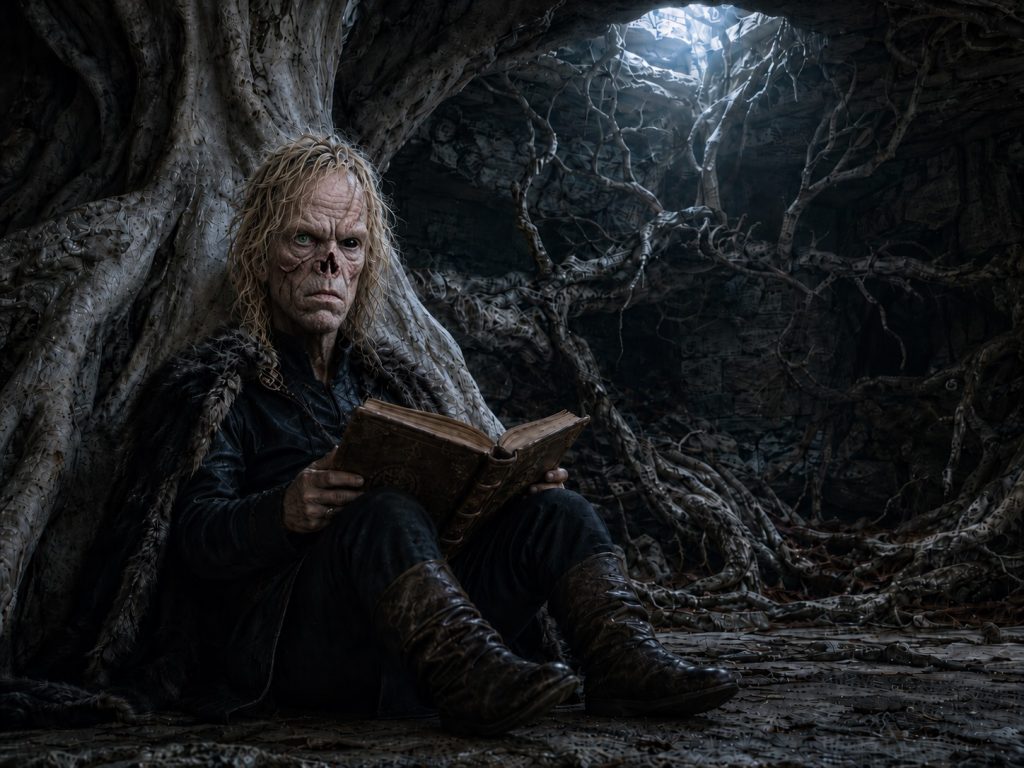
The Stone Garden as Emotional Landscape
The name Stone Garden is almost cruel. A garden should be fertile, full of diverse growing plants. Stone does not normally sustain growth. The name suggests life attempting to exist in an environment that neither wants it nor supports it. That is Tyrion at Casterly Rock. He grows in a family that does not fully nourish him.
House Lannister gives Tyrion wealth and a prestigious name, but not true acceptance. Though he has status, he is often made to feel that he doesn’t belong. He is highly educated but lacks affection. In constrast to a man like Ned Stark, his father does not offer the kindness or support a growing child needs . This is a stone garden indeed: Tyrion’s emotional life reflects these challenges. He longs for afforirmation and genuine warmth, yet frequently slips into cynicism, always bracing himself for disappointment. He seeks recognition but anticipates ridicule from others.
For this reason, his witty manner transcends simple entertainment; it serves as a means of adaptation and advancement within a challenging climate. His enthusiasm for reading may be likened to roots actively seeking water, while his pursuit of knowledge parallels the role of the weirwood as a repository of collective memory. Although his hardships do not justify his cruelty, they undeniably influence his development under adverse conditions. Tyrion’s journey is defined by his efforts to persist in an environment where support is scarce. Symbolically, he is portrayed as a living organism trying to endure in an unyielding stone garden.
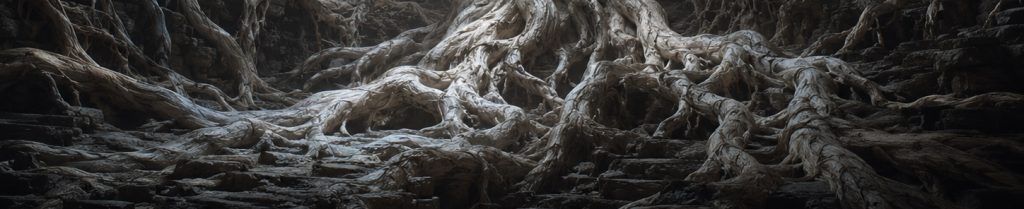
Roots Choking Out All Other Growth
The Stone Garden weirwood can’t grow upward due to the rock ceiling, so it spreads horizontally and dominates the cave ecosystem. This already defines him in terms of his propagation through the narrative, but the image serves as a foundation for further parallels, as it allows for multiple interpretations.
Tyrion as the Choked Growth
At one level, Tyrion represents a figure whose growth was restricted. Analogous to a tree deprived of vertical development, he was unable to attain traditional markers of Lannister authority or legitimate inheritance. Instead, his trajectory moved laterally toward intellectual pursuits – scholarship and an understanding of human behaviour, history, and political systems that might not attract the attention of a conventional nobleman. This stunting fostered a form of intelligence that may not have emerged through standard advancement.
Although Casterly Rock was ostensibly his home, it functioned instead as a source of limitation and psychological constraint. Tywin’s disdain, Cersei’s animosity, his mother’s absence, and the trauma associated with Tysha fashion the emotional root-system that tightens around him.
The Lannister family’s focus on image and status left limited space for a son unable to embody golden family image. Consequently, Tyrion’s becomes the life the Rock does not fully nourish; although fundamentally shaped by adversity, he nonetheless adapts and matures through survival under such pressures.
Tyrion as the Choking Root-System
Yet the metaphor of the mirror is two-fold: Tyrion is not simply strangled by the Rock; he becomes a force that suffocates the Rock from within. By the conclusion of A Storm of Swords, Tyrion achieves what no outside adversary could: after discovering Shae in Tywin’s bed, he kills her, then confronts and murders Tywin on the privy. Killing his father and leaving House Lannister in moral, emotional, and political disarray are aspects of the choking root-system.
Tywin has spent Tyrion’s life trying to confine him, belittle him, humiliate him, exploit him when convenient, and deny him genuine fulfilment. Following the Battle of the Blackwater, Tywin claims all credit and ignores Tyrion’s crucial part in the victory. Tyrion, badly injured, is unceremoniously evicted from his quarters in the Tower of the Hand and relocated into a dingy cell in Maegor’s Holdfast. However, in Martin’s world, suppressed feelings don’t merely fade away. Tyrion’s wounds can be seen as roots that ultimately fracture the structure. The Stone Garden weirwood’s roots serve as an apt symbol for Tyrion’s mounting resentment: unseen by most, tangled and perhaps even sturdier than the tree’s trunk, and impossible to extract without collapsing the cave itself.
The Valonqar and the Choking Root
The choking image becomes even more pointed when viewed in the light of Cersei’s fear of the valonqar prophecy.
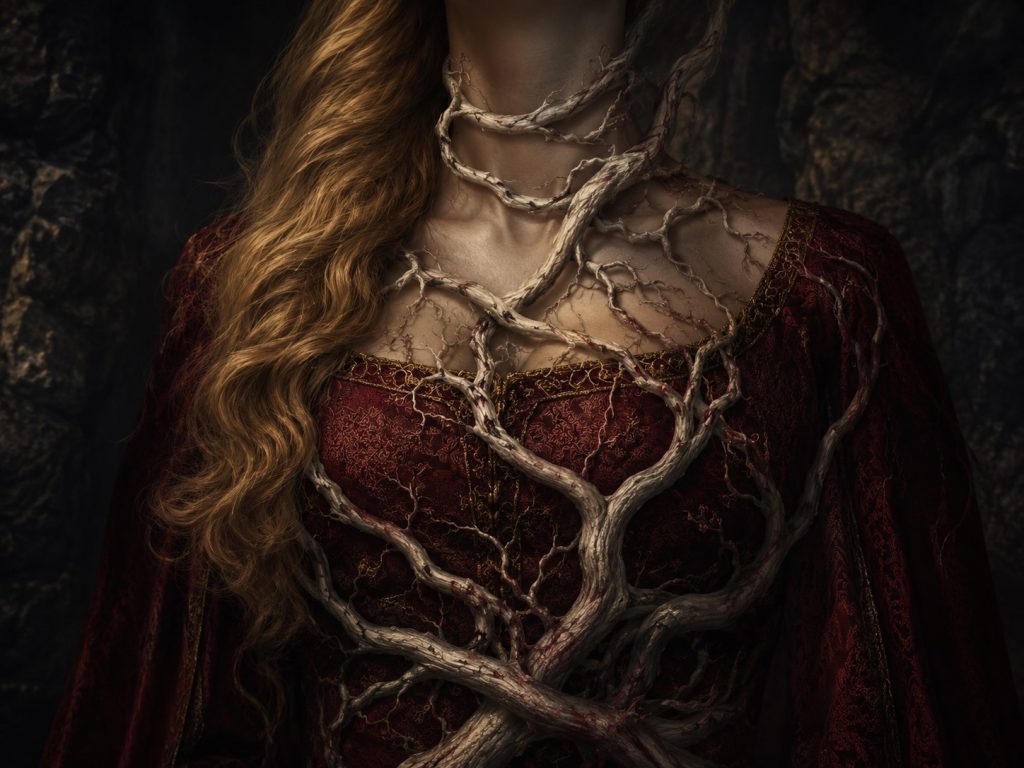
Cersei believes Tyrion is the little brother who will one day choke the life from her. Whether she is right is another question entirely. Prophecy in A Song of Ice and Fire is dangerous precisely because characters misread it, fight it, fulfil it by trying to escape it, or assign it to the wrong person. But the Stone Garden weirwood gives Cersei’s fear a startling physical motif: roots that choke out all other growth.
Cersei imagines Tyrion in similar terms. To her, he is not simply a brother she hates. He is a strangling presence planted in her life from the beginning, the monstrous child whose birth killed her mother, Joanna. He is the dwarf she associates with shame, danger, and prophecy. He is the small thing that should not matter but somehow always does. He is the root she cannot pull out.
This gives us a possible prophetic undertone: Tyrion is the unwanted, twisted thing inside the Rock. The weirwood is the hidden, twisted thing inside the Rock. The tree’s roots choke out other plant life in the cave. Cersei believes Tyrion’s hands will choke her.
The image may however not predict literal strangulation. The choking may be psychological, political, or symbolic. Tyrion may choke Cersei’s power and ambitions. He may stifle the golden Lannister story she tells herself. He may be one of the forces that tightens around her reign until she can no longer breathe inside her own paranoia. Cersei has offered a lordship to anyone who brings her his head but perhaps the little brother is a root in the dark, impossible to remove and capable of strangling the chamber that tries to contain him.

The Chthonic Cave
A godswood usually suggests sky, seasons, wind, leaves, birds, snow, and open nature, while a cave implies burial, secrecy, echoes, and descent. The Stone Garden is therefore less like a garden in the ordinary sense and more like an underworld shrine. A complete godswood in a cave is an inversion.
Tyrion’s life similarly moves repeatedly through underworld imagery and the list is quite long when one takes a closer look: unclogging the cisterns and drains of Casterly Rock, the sky cells of the Eyrie, the black cells and secret passages of King’s Landing, the killing of Tywin in the enclosed privy, the hidden sexual trauma of Tysha, near death at the hands of Ser Mandon Moore, his journey down the Rhoyne through fog, ruins, stone men, and half-mythic river landscapes including another near death by drowning, his psychological descent in exile, his enslavement in Slaver’s Bay.
This does not frame Tyrion as a character of open fields and shining tourney grounds. He is a character of enclosed spaces: hidden passages and a secret house, libraries, brothels, ruins shrouded in fog, sky-cells and dungeons, ancient knowledge and several brushes with death. We can define him as a chthonic figure, bringing him close to several mythic types without reducing him to any one of them.
Victimized Trees, Hunted Dwarf
According to legend, after centuries of strife, the First Men finally accepted the trees after signing a Peace Pact with the children, adopting the old gods and worshipping beneath their branches henceforth. Yet with the coming of the Andals, the weirwoods became targets again. Sacred trees were chopped down, burned, and systematically destroyed across much of the south. The trees of the old gods were emblems of an older spiritual order that the Andal conquerors sought to erase. By the time of the main narrative, wild weirwoods had all but vanished from southern Westeros, surviving mostly on the Isle of Faces and in godswoods – but even here they are enclosed and symbolically domesticated. In the North, beyond the reach of Andal conquest and where the old gods remain stronger , they still grow more freely.
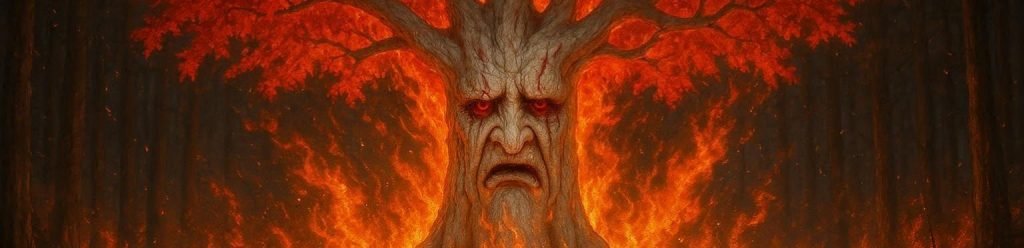
This history gives the weirwoods a surprisingly Tyrion-like trajectory: both are feared and persecuted.
Besides being treated as an aberration within House Lannister and within Westerosi society more broadly, he becomes one of the most hunted men in the known world. Cersei’s bounty turns him into a public target. Worse, it turns his dwarfism into a category of suspicion. Innocent dwarfs are killed even in Essos because someone hopes their heads might be Tyrion’s. Analogous to the destruction of weirwoods, a grotesque purge of Tyrion’s image is conducted, murdering substitutes in place of the man himself. The resemblance to the fate of the weirwoods is difficult to ignore.
Tyrion and the weirwoods thus share similar fates. Both are marked by fear, mutilation, persecution, and survival through containment. And in both cases, the violence directed against them reveals anxiety about what they represent. The Andals did not merely destroy trees. They attempted to erase the spiritual system associated with them.
Likewise, Cersei’s hatred of Tyrion transcends personal disgust. Tyrion threatens the ideological structure of House Lannister itself. He has the capacity to expose its hypocrisies, fragility, and its buried rot. Like the weirwoods lingering in the godswoods of southern castles, he is a reminder that certain truths cannot be completely eradicated.
Bloody Hands
One of the more unsettling aspects of Tyrion’s symbolic connection to the Stone Garden weirwood may lie in the recurring imagery of bloody hands, mutilation, and bodily marking. The parallels become especially striking once we place Tyrion’s scarred face alongside the repeated descriptions of weirwoods as trees with carved faces and blood-red leaves resembling hands.
The imagery appears repeatedly throughout the series:
The weirwood’s bark was white as bone, its leaves dark red, like a thousand bloodstained hands.
— A Game of Thrones, Catelyn I
And later:
The heart tree stood before him, a pale giant with a carved face and leaves like bloody hands.
— A Dance with Dragons, The Turncloak
The phrasing is difficult to ignore. The term “bloody hand” is a metaphor for bloodshed and violence, used often in the Bible to describe the guilt, violence and sin of the wicked. Martin does not simply describe red leaves. He repeatedly invokes hands – specifically bloody hands, visually marking the trees with blood-guilt imagery.
This becomes especially interesting once Tyrion himself becomes associated with bloody hands in rumour, fact and theatrical representation.
In A Feast for Crows, a Tyroshi arrives in King’s Landing, bearing a head he claims to be Tyrion:
In Tyrosh, we name him Redhands, for the blood running from his fingers. A king’s blood, and a father’s. Some say he slew his mother too, ripping his way from her womb with savage claws.
— A Feast for Crows, Cersei VIII
Tyrion is transformed into a creature whose hands are permanently bloodstained: kinslayer, regicide, patricide, monstrous child. The image resembles a figure marked by violence.
Then, in the Mercy chapter from The Winds of Winter, the motif appears again in a more theatrical form:
Beside the entrance, Big Brusco had painted over the title of the last show, and written The Bloody Hand in its place in huge red letters. He was painting a bloody hand beneath the words, for those who could not read.
The play dramatizes the death of King Robert and the drama surrounding the throne. Tyrion is represented within the performance by the dwarf Bobono, making Tyrion the implied “Bloody Hand” of the title.
This matters because the repeated association between Tyrion and bloody hands begins to mirror the visual language of the weirwoods themselves. The sacred trees of the old gods bear leaves like bloodstained hands. Tyrion, increasingly associated with violence and kinslaying, becomes Redhands or the Bloody Hand. Both are tied to acts of bloodshed.
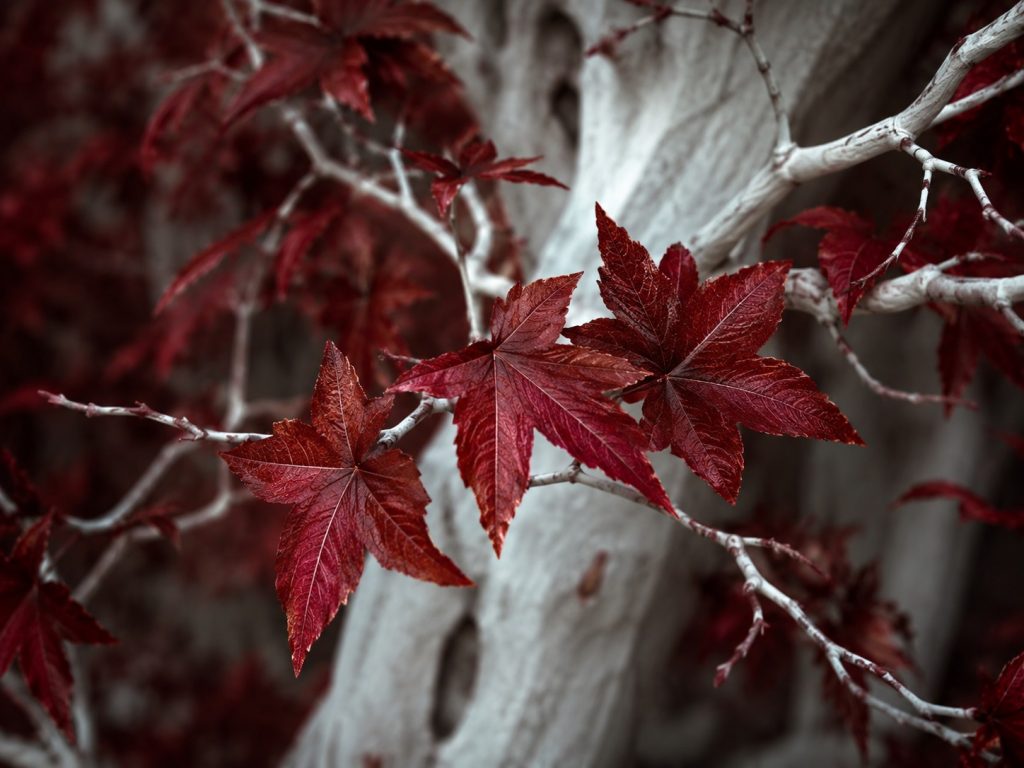
This raises an important question: Are the weirwoods merely witnesses to violence, or are they themselves implicated in it?
What we know about the children of the forest and the old gods repeatedly confirms that weirwood magic is not innocent nature magic in the modern fantasy sense. It is ancient, sacrificial, and rooted in blood. The Hammer of the Waters is one of the clearest examples. According to legend, the children called down catastrophic destruction through blood sacrifice beneath the trees, killing a thousand captive men to break the Arm of Dorne as well as thousands more through through the effects of the Hammer itself. As such, weirwoods participate in systems of sacrificial violence and are entangled with acts of mass death.
But as recent history shows, the Lannisters are also perpetrators of mass killings: Castamere, where the Reynes and Tarbecks were exterminated. The Sack of King’s Landing, where Lannister soldiers slaughtered civilians in the streets. The Red Wedding, orchestrated by Tywin, where almost the entire Stark host was butchered under guest right. Tyrion himself unleashed wildfire on the Blackwater, burning men alive by the hundreds in a single night. The Lannisters did not call down the Hammer of the Waters, but they practice the same logic: mass death as calculated power, blood as currency, survival through ruthless massacre.
Tyrion truly does acquire bloody hands in the biblical sense. He kills Shae. He kills Tywin. He poisons Nurse in Essos. The once falsely accused eventually earns the bloody moniker.
That is a very Martin-like symbolic structure. The victim may become the perpetrator. The once persecuted weirwood with leaves like bloody hands may carry within it the memory – and perhaps the power – of ancient violence. The trees are sacred, yes, but also unsettling. Like Tyrion, they occupy an uncomfortable symbolic space between victimhood and atrocity.
The Carved Face
This becomes even more suggestive once we consider the motif of mutilation and prophetic sight.
Before the Battle of the Blackwater, Tyrion is mocked for his dwarfism, but his face is not yet the open wound it later becomes. After Ser Mandon Moore nearly kills him, however, Tyrion’s face is violently altered. Most of his nose is gone. His scars make him appear increasingly grotesque to others. The smallfolk’s fantasy of Tyrion as monster is now written more visibly onto his face.
This transformation draws him closer to the symbolic language of the weirwoods, which are marked by faces carved into their trunks. The weirwoods’ etched eyes suggest an ever-present vigilance that unsettles some observers, such as Catelyn. Tyrion’s mismatched eyes—one green and one black—make his appearance even more unusual and cause discomfort in those he looks at. After the Blackwater, his facial injuries amplify this uncanniness. He becomes both more difficult to ignore and harder to behold; his body now serves as a testament to the violence he has endured.
This is where Timett son of Timett, a character connected to Tyrion’s arc, becomes relevant.
Timett is a Red Hand of the Burned Men and his title is earned through ritualized self-mutilation. During his clan’s rite of manhood, he burns one of his eyes out of its socket with a hot knife. Because the usual sacrifice is only a nipple or a finger, the extremity of Timett’s act impresses the elders and wins him status. Though young for his rank, he commands enough respect to become the clan chief.
The symbolic cluster is interesting and feels weirwood and greenseer-adjacent : red hand, eye-loss, ritual mutilation, violence, bodily marking as transformation to authority.
The power of seeing in A Song of Ice and Fire repeatedly comes at a bodily cost. Bloodraven loses an eye and becomes bound into the weirwood network. Bran loses the use of his legs before gaining greenseer abilities. Theon stands before the Winterfell heart tree while psychologically stripped apart and remade. Timett destroys an eye and becomes a Red Hand. Tyrion loses his nose and becomes increasingly associated with monstrosity and the Bloody Hand imagery.
The pattern suggests that bodily mutilation in Martin’s world often marks a threshold. The injury is not merely damage but rather analogous to a rite of passage into a different condition, affording access to supernatural power, authority, or altered identity. Tyrion’s scarred face, then, is not only a consequence of battle. It is a sign of a transformation that we as readers are yet to see fully.
The Violent Uprooting
If Tyrion is the root in the dark, then his trial for Joffrey’s murder marks the moment when that root system no longer remains hidden inside the stone. Tyrion is condemned for a murder he did not commit, not because the evidence truly proves his guilt, but because the court is already prepared to believe the story of the dwarf-as-monster. The malformed uncle who hated his nephew the king, earning him the title of kingslayer and kinslayer in one go. Rather than revealing his guilt, the trial only confirms to the reader how thoroughly Tyrion’s own family and Westerosi nobility have cast him into the role of the villain.
And Tyrion knows it.
His response is instructive. Rather than working the system with the intelligence that has served him so well, he detonates. He insults the judges and his father. He provokes the audience. And having lost any faith in obtaining fair justice via those authorized to try him, he demands a trial by combat.
This is not the behaviour of a root system patiently surviving by pressure and infiltration. This is the behaviour of a tree that has decided, suddenly and with complete finality, that it will change its mode of survival or die in the attempt. That matters because, until this point, Tyrion’s genius has so often been adaptive. At the Eyrie, he survives through intelligence and wit. In King’s Landing, he endures through astute assessments of situations, cunning and manipulation. His plan for the defense of King’s Landing is both ingenious and diabolical and he shows real courage during the Battle of the Blackwater.
But at the trial, something breaks. Or rather, something refuses to keep bending. His demand for trial by combat is a rejection of the entire structure that has contained him: father, sister, court, king, law, reputation, family name. Oberyn Martell’s intervention briefly turns this act of self-destruction into something like hope. Unfortunately, Oberyn’s death at the Mountain’s hands returns Tyrion to the dungeon and to the execution he had courted.
What follows is crucial: Like the locked-in tree that cannot leave, Tyrion does not engineer his own escape. Jaime decides to free him while Varys facilitates the passage. Tyrion is, in the most literal sense, carried out of the stone, the uprooting performed upon him by other hands.
As such, he does not break his chains. He is transplanted.
And on the way out, he kills Shae and then Tywin.
These are the acts of a man suddenly and violently released from the structure that has contained him, lashing out at the two figures who most immediately embody his inner torture and imprisonment: his beloved Shae, who turned intimacy into betrayal, and Tywin, who has defined and constrained his life from its beginning. His violence against them is reactive, not strategic.
That distinction matters because Tyrion’s killing of Tywin is an emotional reaction. I doubt he thinks of the act in terms of a political coup during its execution. He does not seize Casterly Rock or King’s Landing, but inadvertedly replaces the old order with a new one in which Cersei seizes the chance to assert her long desired aspirations to maximum power.
This tells us something important: He destroys the father-root, the hard central stone around which so much of his own distortion has grown, ushering in a regime that may well end in disaster for the House of Lannister. But at the same time, on a personal level, Tyrion, freed from the stone, has no immediate direction or agency. Once torn away, he is not liberated in any clean sense. He is simply unmoored: he is firmly in the grip of fate, thrown into situations that require absolute resilience of body and mind.
The Transplantation and its Wounds
A root system violently removed from its cave does not immediately become a happy tree in the sunlight. It tears and bleeds and carries some of the stone with it. As readers, we discover that the Tyrion who arrives in Essos is psychologically darker than the Tyrion who defended King’s Landing. Though the ruthlessness that emerges after Tywin’s death is not entirely new, the capacity was always there. We have seen Tyrion threaten, manipulate, and kill in battle before. But after the escape, that side of him is no longer defensive in nature. It has been activated, and more importantly, chosen.
His desire for the deaths of Cersei and Jaime is not political calculation. Cersei’s inclusion in that hunger is not surprising because she hated him for most of his life. But Jaime’s inclusion is devastating, because Jaime was the one family member Tyrion truly trusted and loved. Jaime was the golden exception, the brother who always treated him with decency and the one Tyrion believed he could forgive anything. Until the truth about Tysha.
That revelation does not merely reopen an old wound. It reveals that the wound was never what Tyrion thought it was. His deepest humiliation was built on a lie, and Jaime not only participated in that lie, but helped preserve it for years. The story Tyrion had used to survive his own trauma – that Tysha had never loved him, that he had been foolish, that the cruelty suffered by Tysha was at least attached to some ugly truth – collapsed.
So when Tyrion enters Essos, he is not simply an exile. He is a torn cutting removed from the stone that deformed him, uprooted and transplanted, and not gently at that.
In Westeros, Tyrion’s name both harms and protects him. It makes him hated, but it also makes him valuable. It gives him access to power, wealth, fear, and recognition. Even those who despise him know what a Lannister is. In Essos, that name carries less weight, if any at all. He is hidden, transported, abducted, sold, enslaved and renamed. The Lannister name that once protected him becomes meaningless, a liability or something to exploit. In effect, the stone garden that symbolically confined him had also, paradoxically, sheltered him from becoming entirely unmoored.
This does not redeem the Rock but it complicates the tree-symbol. The Stone Garden is not only a symbol of confinement and restraint. It represents his dark sanctuary: the place that both formed and deformed him and gave him roots strong enough to survive. The tragedy is that once those roots are torn from the stone, survival becomes a different question. Not “How does Tyrion endure confinement?” But: How does Tyrion live without the thing that confined and perhaps even sheltered him?
This is why the Stone Garden parallel does not end when Tyrion leaves the Rock. The weirwood in the cave shows us Tyrion as the hidden root inside the Lannister stone. His exile asks what happens when that root is ripped out and carried across the sea.
Tyrion has been unleashed. In Essos, he has to decide whether he will grow only toward vengeance – toward Cersei, Jaime, Westeros, and the ruins of his name – or whether he can attach to something else.
What The Stone Garden Reveals
If we allow the Stone Garden weirwood to function as Tyrion’s symbolic mirror, several possibilities open.
Firstly, although Tyrion is physically exiled from Casterly Rock, his story remains intrinsically linked to it. The tree grows within the Rock, symbolizing Tyrion’s own deep-seated connections there. Even as he leaves Westeros, travels across the narrow sea, navigates Essos, and enters the world of dragons and sellswords, Casterly Rock endures as the source of his most profound wounds. Returning to Casterly Rock would be logical, though not necessarily a simple victory; unresolved matters with the Rock, House Lannister, and the painful memories tied to that place linger still.
Secondly, Tyrion may become the one who exposes the vulnerabilities of Casterly Rock itself. He knows the castle inside and out, is familiar with the system of drains. He could be the key to an enemy take-over of the castle.
Thirdly, the Stone Garden weirwood may warn us about Tyrion’s darker path. A root system can hold a cave together, but it can also strangle it. Tyrion’s personal history and significant challenges could lead to inner wisdom, or it could become psychological poison. His chapters in A Dance with Dragons already show him moving through bitterness, self-loathing, vengeance, and moral ambiguity. Like the tree that has choked out all other growth, that is not a comforting image.
It raises the question: will Tyrion become the root that breaks House Lannister and makes new growth possible, or the root that strangles whatever remains of his house when Cersei is done with it?
We can also ask what this might mean in respect of the tree itself. Will the Stone Garden weirwood’s powers be unleashed in the supernatural sense and if so, by whom and to what effect?
The Stone Garden therefore offers a darkly elegant image of Tyrion’s arc: the hidden root beneath the golden house; the twisted presence in the cave; the puny thing that cannot be contained; the constrained life that may either hold the stone together or crack it apart.
The weirwood’s red leaves ask us to look again.
So does Tyrion’s scarred face.
All images are AI-generated.